
Development Update8 min read
Devlog Volume 0: The Beginning
A full tour of the private build as it stands today. What a day at the academy looks like, which systems already work, what is held together with tape, and what is being built right now.
What this entry covers isStatus: In development
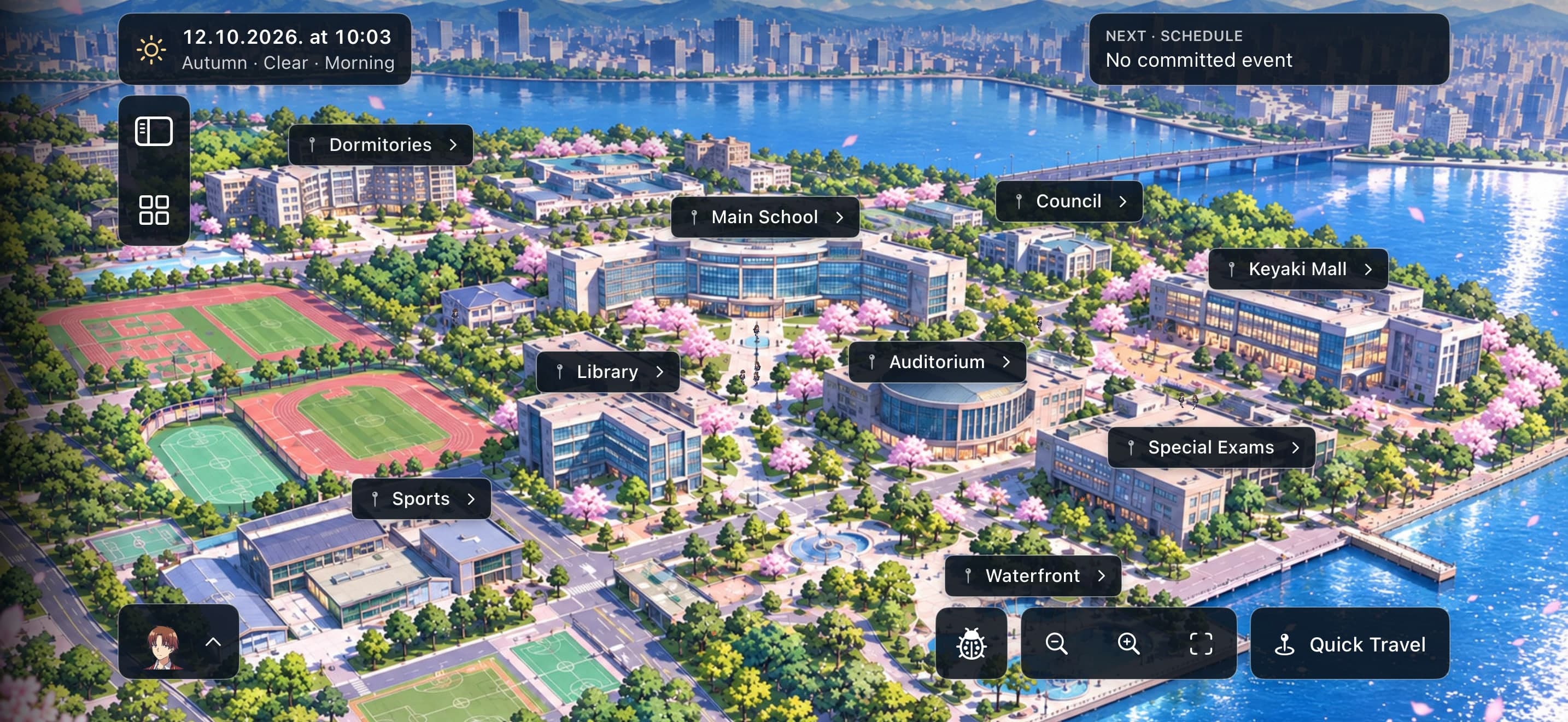
Welcome to Volume 0.
These numbered volumes are where I will write about The Merit Academy in depth: what was built, how it works, what went wrong and what comes next. Volume 0 is the baseline. It describes the game exactly as it exists in the private build today, so that every later volume has something to be measured against.
It is long. There is a lot to cover.
The idea, in one paragraph
You enrol at an elite academy where everything is measured. Your class shares a score. Your allowance depends on it. Classes are ranked against each other, and only the one on top at graduation gets what the academy promised. Around you are classmates who are also competitors, exams that are not really about the exam, and a school that carries on with its day whether you are watching or not.
That last part is the one I care about most, and it shapes almost every technical decision below.
How a day works
A school day runs on a real timetable. Lessons are from 08:00 to 14:00. After that the day is yours, within limits: you get a small number of optional actions and a small number of requests you can make of other people. Studying, training, resting, visiting someone, helping a classmate and looking into something you are curious about all draw from the same short supply.
The current build ties one school day to one real day. You choose to commit to a school day, you live it, and the next one opens after midnight. If you skip a real day, nothing piles up and nobody marks you absent. If you commit and then miss a lesson, it costs you and it costs your class.
I want to be clear that this pacing is experimental. I like what it does to decisions, because a day you cannot replay is a day you think about. I do not yet know how it feels over several weeks, because nobody has played it for several weeks. It may change.
What exists in the build today
Everything in this section is working in the private build. Where something is thin, I say so.
Lessons and exams
- Lessons are interactive. Each has notes, worked examples and questions you answer yourself, with feedback. There are thirty topic lessons across five subjects and 180 questions behind them.
- You can put a lesson away and resume it later without losing your place.
- Practice papers let you find out where you stand with nothing at stake. Graded papers are scored literally: ten questions, and your mark is the number you got right.
- Mistakes are saved to a notebook, and you can go back and repair them.
- Classmates can be in academic trouble. You can tutor them, which takes time you could have spent on yourself, and it is possible for a student to leave the academy for good.
The campus
- A full campus map you can pan and zoom, with nine destinations that open into their own illustrated scenes.
- Classrooms, with your actual timetable and a seat that is yours.
- A library with twelve books you can borrow for one to ten days. Borrowed books turn up on the shelf in your room, and what you learned from them stays after you return them.
- Your dormitory room: study, rest, phone, inventory, and a few upgrades you can buy for it.
- A mall with a shop and a café. Thirty-six real products between them. You can buy food for later, buy a gift for someone specific, or take a table and invite a person to join you.
- Sports facilities with three playable clubs (basketball, archery and soccer), practice sessions and match results. Three more clubs are on the sign and not yet open.
- A faculty office, where you can consult a teacher, register for things and file an appeal.
- Every venue has opening hours, and they are enforced.
People
- An in-game phone, for the people you have actually met. You do not get the whole school's numbers on day one. You introduce yourself, talk, and ask to exchange contacts.
- Twenty-four branching conversations with two real decisions in each, plus six group scenes where several people respond individually.
- Appointments are made for a real time and place, with travel time. The other person can say no, suggest somewhere quieter, or already be busy.
- Relationships are directional and made of more than one number. Somebody can respect you without liking you.
- Characters keep a record of what has happened between you: an introduction, a tutoring session that worked, a gift, a promise. The People screen shows that shared history, and conversations can refer back to it.
- In lessons you can whisper or pass a note to someone sitting near you. The teacher's attention is a real risk.
- Friendship is a complete path on its own. For a small number of characters, something closer is possible, and only if it is mutual.
The living academy
This is the system the game is named for in my head, even if it is not on the title screen.
- Every character has a location at every moment, worked out from one shared set of rules: the timetable, their club, their appointments.
- If a character is walking between two commitments, they appear on the campus map as a portrait moving along the actual route, for as long as the walk takes.
- If they are indoors, they are not drawn outside. During lessons the map is nearly empty, because everyone is in class.
- Inside a building, a "People Here" panel shows who is really present, what they are doing and whether they can be approached. Small groups form. Occasionally someone starts a conversation with you.
- The campus has five moods driven by the calendar and the clock: spring, sunset, night, rain and winter. Weather is atmosphere. It never cancels a commitment.
The foundation is real, but the routines on top of it are still simple. Movement currently follows commitments. Personal habits, teachers with days of their own and events that pull people off their normal path are all still to come.
Money and consequences
- Your allowance is derived from your class's score. There is a dated ledger of everything you earned and spent.
- Other students have finite budgets too. You can make agreements with them, and those agreements are recorded.
- Staying out past curfew is a choice with evidence and a penalty attached.
The long game
Under all of this sits a full campaign structure: ninety school days across three academy years, nine major examinations with unusual rules, and a graduation decided by final rank. Automated playthroughs reach the end of it.
That is not the same as it being finished. The skeleton holds from the first day to the last. Whether it is well paced, fair and interesting for ninety days is a question only real players can answer, and none have tried yet.
Under the hood
For those who like this part:
- The game is being built and tested on iPhone, as a native app. The final list of platforms is not decided.
- The simulation is separate from the interface. The rules of the academy live in a core with no screens in it at all, which takes commands and produces a new state. Given the same starting point and the same choices, it produces the same result every time.
- That separation is what makes the living academy honest. The map, the schedule, the phone and the reminders all ask the same source where a person is. There is no second calendar that can disagree with the first.
- It is also what makes testing possible. There are more than five hundred automated tests, and tools that play entire campaigns with different strategies to look for broken balance.
- There is no account, no server and no connection needed to play. Everything is on your device.
- Saving is automatic, with a backup behind it and three manual slots. Older saves are migrated rather than abandoned.
- Optional reminders can tell you when a lesson, a club practice or an appointment is coming up. They only ever fire for things that are confirmed.
In round numbers, the project is about 40,000 lines of code today.
What is not done
This list matters as much as the one above.
- Nobody outside has played it. There is no public build and no test build. Difficulty and pacing are my guesses.
- The cast and the lore are not final. The private build runs on a stand-in cast while the systems are built. The academy's own characters, names and history are a milestone of their own on the roadmap, and what you see in screenshots will change.
- Real-device checks are incomplete. Performance, memory, touch behaviour and accessibility on physical phones still need a proper pass.
- Content is thin compared to the systems. Thirty lessons is a start. Three years of school needs far more.
- There is no audio.
- The first hour is not good enough. Which brings me to the present.
What I am working on right now
The opening.
At the moment a new game starts with several pages of text explaining the academy, and then leaves you on a very large campus with every system available at once. It works, and it is the wrong way to meet this game.
The replacement is an arrival that happens inside the world:
- Day Zero. You arrive. The first thing you see is the campus itself, not a form. You meet one classmate at the school entrance, and how you answer them is remembered. You walk to the main building, sit through one short sample lesson, make one social choice and find your room.
- The first week. The campus opens a few places at a time. Each new system is introduced at the moment you have a reason to use it: the mall when you are hungry, the library when there is something to prepare for.
- Then the guidance stops. By the second week the whole campus is open and the game trusts you with it.
A few rules I am holding to while building it. The tutorial uses the real systems, so the lesson you take on Day Zero is a real lesson screen and the person you meet is a real entry in your contacts. It can be closed and resumed at any point without repeating a first meeting. And it never punishes you for the hour you happened to start playing at.
That work will be the subject of Volume 1.
How to follow along
Each volume will be a write-up like this one: what changed, with screenshots from the build, and an honest list of what is still missing.
If you have a question about anything above, ask in the comments. If there is something you want the academy to have, tell me. I read all of it, and this is the stage of the project where it can still change what gets built.
Thank you for being here at Volume 0.
- volume 0
- overview
- state of the build